It started on a playground in Hawke's Bay, 1968.
I was six years old. New school. New grey shorts, the thick cotton kind. I walked through the orchard to get there, Golden Queens rotting on the ground, that heavy sweetness you only get when fruit finally gives up.
I walked toward two boys. Asked if I could play. "Go away. You're too big." Not cruel. Just a fact, delivered the way you'd say it's Tuesday. They kept playing like I hadn't spoken. And something cracked.
That's when I made the decision. Not in words. Not consciously. But a decision nonetheless: needing people was dangerous. Better to be impressive. Better to be the one people needed instead of the one doing the needing.
I didn't understand until much later that I'd spend the next fifty years paying for that choice.
The Years That Looked Like Success
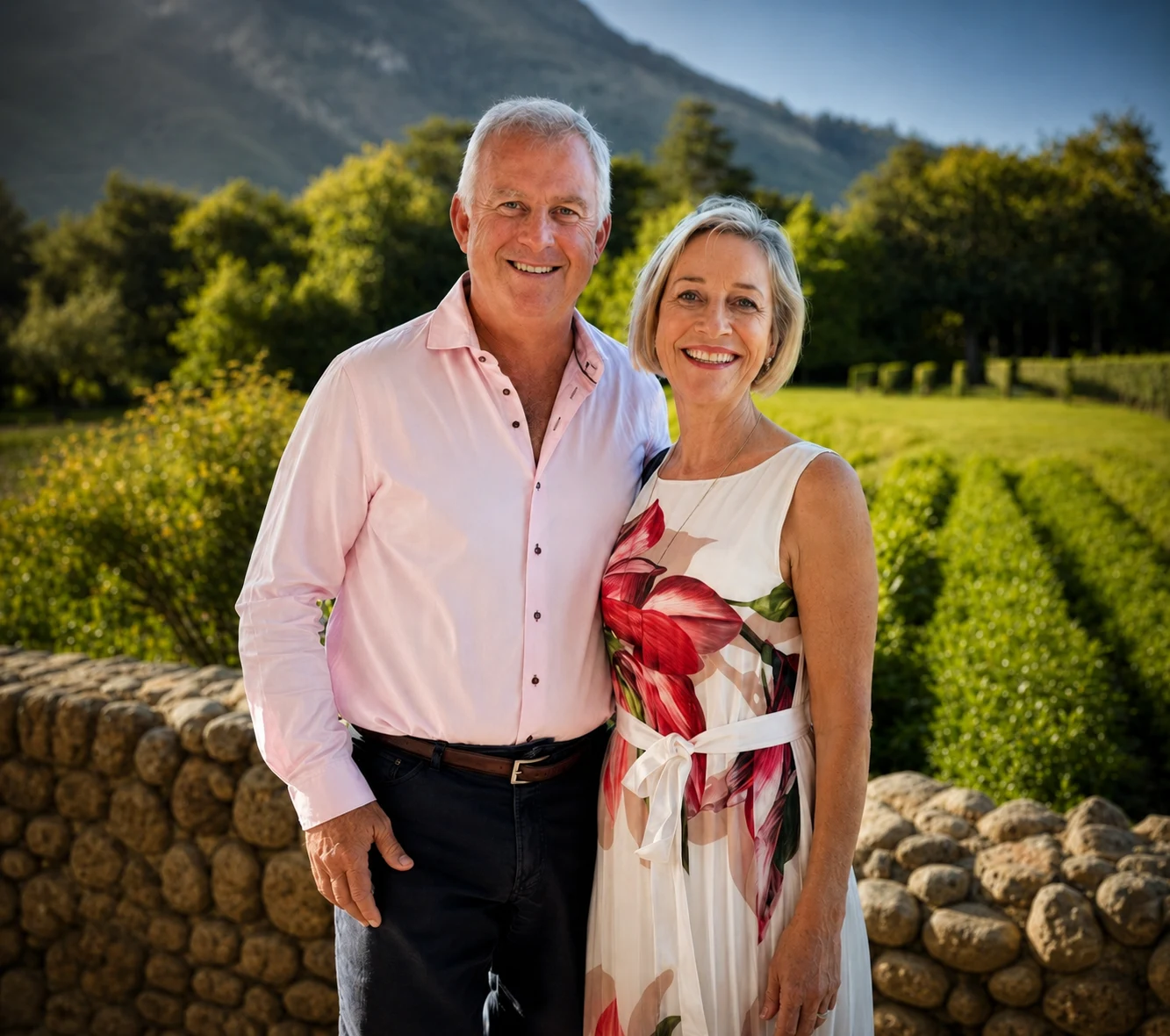
Christine and I met studying Horticultural Science. Before we built anything together, I moved into financial services, leading major teams for AXA and Prudential across New Zealand. I was good at the performance. Very good.
Then we built a portrait photography business that took us around the world. Royal connections. Photographing sultans. Limousines to palace gates. Two businesses, one in New Zealand, one in Australia. By every visible measure, we had everything. And underneath it all, my wife had been trying to reach someone who wasn't actually there.
Rachel. Seven years old. Back seat of a car.
I came home from Malaysia. Hollow. Jet-lagged. Rachel was in the back seat, still young enough to believe I might actually choose her. We were driving somewhere ordinary, a Tuesday errand that wouldn't make it into any performance review. I don't remember where we were going. I just remember what she said.
"I just want you and Mum."
Not the royal photographer. Just me. The actual person underneath the performance. I heard it. I knew she was right. And I got on another plane.
Christine packed her bags.
I walked up the stairs and the bags were there. Not hidden. Not dramatic. Just sitting at the top of the stairs the way a fact sits when it's finished waiting to be acknowledged.
We had everything. Two businesses. An international reputation. Three children. The life we'd built looked extraordinary from the outside. And inside our own home, my wife had been trying to reach someone who wasn't actually there. Who delivered presence without offering it. Who checked boxes instead of showing up.
I was in the kitchen next door, quiet sobs I couldn't control. And I was thinking: the same protection that kept me safe on the playground in 1968 was destroying everything that actually mattered in 2000.
"The costume had kept me safe. And it was killing me."
I sold the photography business. Not because it made financial sense. Because nothing else made any sense at all if I lost my family.
What We Built From the Wreckage
Christine and I trained as certified professional counsellors at New Zealand's first and most respected family therapy centre, working across Maori, Pacific, and diverse cultural backgrounds. Gottman, Imago, EFT. The full range of evidence-based approaches to relationship and family therapy.
I went on to serve as Regional Manager for New Zealand's largest Employee Assistance Programme, working with Australia's top 100 companies. Hundreds of Family Court custodial mediations. Together Christine and I co-founded Aroha Leadership and led the Global Women's Leadership Summit from 2013 to 2016.
But the real work, the work that actually transforms people, came from inside our own wreckage. It goes beyond any method. It works at the level of being, not behaviour. Once you understand that distinction, you can't un-see it.
Bernardo O'Higgins Award, the highest honour conferred by the Government of Chile upon a foreign dignitary. Grant is among a small number of practitioners globally trained in the 3D Relational Simulation methodology developed by Dr Carlos Raimundo.
If something brought you to this page, I don't think that's an accident. The work is right here whenever you're ready.